
How to Deal With the Grief of Losing a Dog
If you’ve recently lost a dog, you may be discovering that grief shows up in places you never expected.
You wake up and, for just a moment, forget.
You walk toward the place where the food bowl used to be.
You come through the door expecting to hear familiar footsteps.
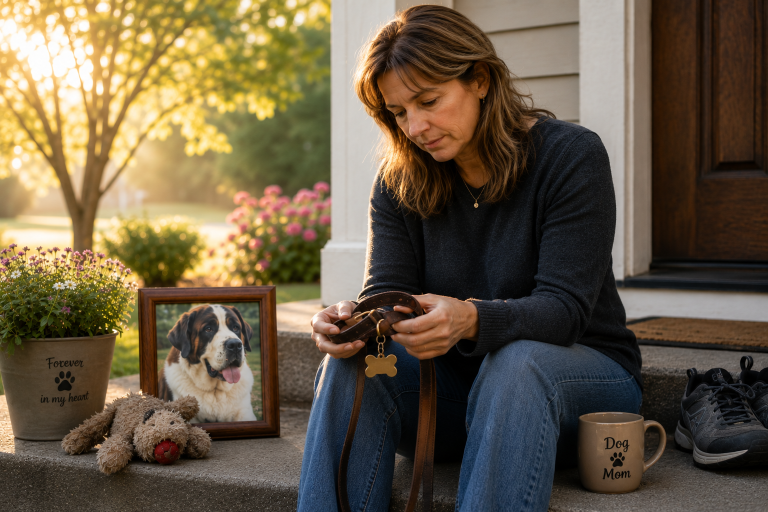
You see the leash hanging where it always has.
Maybe you find a favorite toy tucked underneath a piece of furniture and suddenly you’re crying all over again.
When you’re trying to understand how to deal with grief of losing a dog, one of the first things I want you to know is that this can be a very real and very significant loss.
You haven’t simply lost a pet.
You may have lost a companion, a source of comfort, part of your daily routine, and a relationship that was woven into hundreds of ordinary moments of your life.
And those ordinary moments are often exactly where grief finds us.
Why Losing a Dog Can Hurt So Much
The bond we form with dogs can be incredibly deep.
Think about how much of life they quietly witness.
They’re there on ordinary Tuesday mornings.
They’re there when you come home after a terrible day.
They’re beside you when you’re sick, tired, lonely, excited, grieving, celebrating, or simply sitting on the couch watching television.
They don’t need an explanation for your mood.
They don’t expect you to have the right words.
They’re simply there.
That kind of consistent companionship can become an important source of emotional connection and comfort.
Research into the human-animal bond continues to examine the ways relationships with animals can affect our emotional and physical well-being. The American Veterinary Medical Association’s information about the human-animal bond describes this bond as a mutually beneficial relationship between people and animals that can influence the health and well-being of both.
So when that relationship ends, it makes sense that the grief can be profound.
Your dog mattered.
And because the relationship mattered, the loss matters too.
Understanding Grief After the Loss of a Dog
One of the difficult things about grief after losing a dog is that there isn’t a correct way to experience it.
You might cry constantly at first.
You might feel numb.
You may have moments when you feel almost normal, followed by a wave of grief that seems to come out of nowhere.
You might feel angry.
You might feel lonely.
You might even find yourself laughing at a wonderful memory and then feeling guilty for laughing.
Grief isn’t a straight line.
It doesn’t neatly move through stages until one day you’re “finished.”
It tends to move more like waves.
Some days the water feels relatively calm.
Other days a memory, photograph, anniversary, sound, or familiar routine can bring the grief rushing back.
That’s not necessarily a sign that you’re going backward.
It’s part of grieving someone who occupied a meaningful place in your life.
Why Pet Loss Grief Can Affect Your Daily Life
When a dog is part of your everyday routine, their absence can change the rhythm of your entire day.
Maybe you used to wake up early because they needed to go outside.
Perhaps you walked together every evening.
Maybe they followed you into the kitchen while you made dinner or curled up beside you when you worked.
When they’re gone, you aren’t confronted with their absence just once.
You may encounter it dozens of times throughout the day.
That disruption can affect sleep, appetite, concentration, motivation, and your overall emotional wellness.
You may even find yourself avoiding certain rooms, routines, walking routes, or places because they remind you of your dog.
When you’re coping with the loss of a pet, give yourself permission to acknowledge these changes instead of expecting yourself to immediately return to normal.
Your normal has changed.
It takes time to adjust.
Guilt After Losing a Dog
This may be one of the hardest parts of pet loss.
Guilt.
“Did I do enough?”
“Should I have noticed something sooner?”
“Did I wait too long?”
“Did I make the decision too soon?”
“What if I had tried one more treatment?”
“What if I had made a different decision?”
These questions can be especially painful when you’ve had to make an end-of-life decision for a beloved dog.
Grief has a way of making us look backward with information, emotions, and perspective we didn’t necessarily have when we were making the decision.
We search for another ending.
Sometimes we search because accepting that there wasn’t a perfect choice feels unbearable.
If you’re struggling with guilt, try remembering the circumstances as they actually were—not as grief is rewriting them today.
What did you know at the time?
What were you being told?
What was your dog’s quality of life?
What decisions were you trying to make out of love?
You made decisions with the information and resources available to you in that moment.
Grieving minds often search for certainty after a situation in which certainty simply wasn’t possible.
Be gentle with yourself there.
How to Deal With the Grief of Losing a Dog
If you’re searching for how to deal with grief of losing a dog, you may be hoping for something that will make the pain disappear.
I wish grief worked that way.
Instead of trying to eliminate grief, it can be more helpful to learn how to carry it while allowing yourself to heal.
Start by giving yourself permission to grieve.
You don’t need to justify why you’re hurting.
You don’t need to decide whether you’ve been sad “too long.”
And you certainly don’t need to compare your grief with someone else’s.
Try to care for your body while your heart is hurting, too.
Eat something even when you don’t have much appetite.
Maintain a reasonable sleep routine when possible.
Take a walk.
Step outside.
Keep some structure in your day.
These things don’t erase grief, but they can provide stability when everything else feels different.
And talk about your dog.
Say their name.
Tell the stories.
Remember the ridiculous things they did.
Look at the photographs when you’re ready.
You don’t have to remove someone from your memories in order to heal from losing them.
Healthy Ways of Coping With Pet Loss
Coping with pet loss often involves finding ways to make room for both sadness and connection.
You might create a photo album or memory box.
Frame a favorite photograph.
Keep their collar or identification tag somewhere meaningful.
Plant flowers or a tree.
Write your dog a letter.
Write down your favorite memories before you’re afraid you’ll forget them.
Some people find comfort in making a donation to an animal shelter or rescue organization in their dog’s memory.
Others simply need quiet time.
There isn’t one correct ritual.
Choose something that reflects what the relationship meant to you.
The Association for Pet Loss and Bereavement also provides pet-loss information and support resources for people grieving the death of a companion animal.
Finding Meaningful Ways to Remember Your Dog
Healing doesn’t require forgetting.
That’s something I think people sometimes need permission to hear.
Your relationship with your dog was part of your life.
Those years don’t disappear because your dog is no longer physically present.
You may eventually be able to remember them with more smiles than tears.
That doesn’t mean you’ve stopped loving them.
It means the relationship has found a different place in your story.
And if you’re wondering when you should get another dog, there isn’t a universal answer.
Some people find that opening their home to another animal brings comfort.
Others need months or years.
Some decide they don’t want another dog at all.
Another dog isn’t a replacement.
And choosing not to have another dog doesn’t mean you loved the one you lost more deeply.
There is no timetable you need to follow.
When Other People Don't Understand Your Pet Grief
Unfortunately, not everyone understands the depth of pet loss.
Someone may say:
“It was just a dog.”
Or:
“You can always get another one.”
Those comments can hurt enormously.
Pet loss can sometimes become a form of disenfranchised grief—grief that isn’t fully acknowledged, understood, or supported by other people.
If you’ve experienced that, you may find our article Disenfranchised Grief: When Your Loss Isn’t Recognized helpful. It explores what happens when you’re grieving something deeply meaningful but feel as though the people around you don’t understand why it hurts so much.
Try to seek out people who do understand.
You don’t need everyone to validate your grief.
But having even one person who can listen without minimizing the relationship can make the experience feel less lonely.
Sometimes Grieving a Dog Begins Before the Loss
Grief doesn’t always begin after death.
If you’ve cared for an aging dog or received a serious diagnosis, you may recognize the strange experience of grieving while your dog is still beside you.
You may find yourself looking at them and thinking:
“How much time do we have?”
Then you feel guilty for thinking about losing them when they’re still here.
This experience is called anticipatory grief.
If you’re currently facing this situation, our article Anticipatory Grief: Grieving Before a Loss Happens explores why grief sometimes begins before the actual loss and how to cope with the emotions that can accompany it.
Sometimes understanding what we’re experiencing makes it feel just a little less frightening.
When Counseling May Help With Pet Loss Grief
Most grief doesn’t need to be “fixed.”
Grief is a human response to losing someone we love.
But sometimes pet loss grief becomes very difficult to carry alone.
You may feel isolated because other people don’t understand.
You may become stuck in guilt surrounding your dog’s death.
The loss may bring up earlier losses or unresolved grief.
Or you may simply need somewhere you can talk about your dog without feeling as though you should be “over it.”
Counseling can provide a place to do that.
At Animal Assisted Counseling of Indiana, we understand that relationships with animals can hold tremendous emotional meaning. Our client-centered approach creates space for grief without judgment, pressure, or expectations about what your grieving process should look like.
If you’re in Munster or Northwest Indiana and grief is becoming difficult to carry alone, you can learn more about counseling at Animal Assisted Counseling of Indiana.
You don’t have to wait until you’re completely overwhelmed to reach out.
Sometimes support simply means having somewhere safe to put down what you’ve been carrying for a while.
A Gentle Reminder About How to Deal With the Grief of Losing a Dog
If you’ve reached this article because you’re trying to understand how to deal with grief of losing a dog, I want to leave you with something simple.
Your grief reflects a relationship that mattered.
You don’t have to rush it.
You don’t have to explain it.
And you don’t have to stop loving your dog in order to heal.
There may always be moments when you miss them.
A photograph.
A familiar walking route.
The sound of another dog’s collar.
An empty place beside the couch.
And eventually, alongside the sadness, there may also be gratitude.
Gratitude for the ordinary mornings.
The walks.
The silly moments.
The comfort.
The companionship.
The years—or perhaps the far-too-short amount of time—you were fortunate enough to share.
Coping with pet loss isn’t about leaving your dog behind.
It’s about learning how to carry the love forward while gradually learning how to live with the absence.
One day, the memories that make you cry today may also make you smile.
And when that happens, it doesn’t mean you’re forgetting.
It means love is beginning to take up a little more space than the pain.